


Fixed laser pyrometers
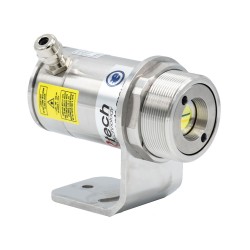
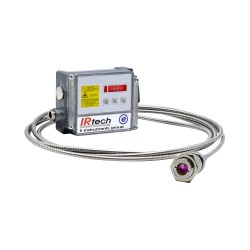
Our range of fixed laser pyrometers offers essential tools for high-precision temperature measurements in industrial environments. These pyrometers provide accurate and consistent readings, ideal for the continuous monitoring of production and maintenance processes. With their advanced laser technology, they offer reliable performance even in the most demanding conditions. Easy to install and use, our fixed laser pyrometers are the perfect solution for companies seeking efficiency, reliability, and precision in thermal measurements.



Technical FAQ:
Fixed laser pyrometers
What is a fixed laser pyrometer?
It is an infrared pyrometer designed for permanent installation on a process line or machine, equipped with a visible laser pointer for correct alignment during mounting. Once installed and aligned, it operates continuously 24/7, transmitting the temperature signal to PLC, DCS, or SCADA control systems.
What is a fixed laser pyrometer used for?
It is used for continuous monitoring of the temperature of a specific point in a production process (furnace, extruder, rolling line, product moving on a conveyor), transmitting the value in real time to automation systems for process regulation, quality control, or safety.
In which sectors are fixed laser pyrometers used?
They are used in metallurgy (rolling mills, foundries), glass industry, ceramics, cement industry, plastics (extrusion, molding), food industry (drying, cooking), paper mills, automotive, semiconductors, and in every industrial process requiring continuous non-contact temperature monitoring.
Why is the laser useful in a fixed pyrometer?
The laser is essential during the initial installation and alignment phase: it allows verification that the pyrometer is aimed exactly at the target object and not at surrounding structures. After alignment, the laser can be deactivated during normal operation, or kept active for periodic checks of correct aiming.
What is the difference between a fixed and portable laser pyrometer?
The fixed model is designed for permanent mounting with a robust IP65/IP67 housing, industrial outputs (4–20 mA, Modbus, Profibus), and mains power supply; the portable one is battery-powered, ergonomic, with an integrated display and designed for spot measurements by an operator.
What analog and digital outputs do fixed laser pyrometers offer?
Standard outputs are 4–20 mA (2 or 3-wire), 0–10 V, relay contacts for alarms, RS485 Modbus RTU, Profibus DP, Ethernet/IP, and Modbus TCP. Premium models also integrate HART for remote configuration via HART communicator.
What temperature ranges do fixed laser pyrometers cover?
The range covers from −50 °C to over 3000 °C, with specific models for each range: low temperature (−50/+500 °C, for HVAC and plastics), medium (200/1200 °C, for metals and ceramics), high (500/3000 °C, for melting furnaces, glass, incandescent metals). Selecting the correct range is fundamental to maximize resolution and accuracy.
How is a fixed laser pyrometer correctly installed?
Installation follows key steps: positioning the sensor at the optimal distance for the required D:S ratio, aligning via laser on the target object, optional use of accessories (air purge for optical protection from dust, cooling tubes for high-temperature environments, anti-vibration mounts). For details, see: Industrial infrared pyrometers: how to choose.
Are special accessories needed for harsh environments?
Yes, for dusty environments air purges are used (compressed air nozzles that keep the optics clean), water-cooled tubes for very hot environments, sapphire or ZnSe protection windows for separation between the hot zone and sensor, standardized mounting flanges, and double-shielded compensated cables for electromagnetically disturbed environments.
What certifications do fixed laser pyrometers have?
Professional models are certified CE (European conformity), IP65/67/68 for mechanical protection, ATEX for use in explosive atmospheres (specific models), SIL 2 according to IEC 61508 for functional safety applications, and EMC for industrial electromagnetic compatibility.
What are the advantages of fixed laser pyrometers over thermocouples and RTDs?
Fixed laser pyrometers offer non-contact measurement (no sensor wear), faster response time (typically 1–100 ms vs. seconds for thermocouples), measurement on moving or inaccessible objects, extended range toward high temperatures (over 2000 °C where high-T thermocouples are fragile and expensive), and no chemical drift over time.
How often does a fixed laser pyrometer need calibration?
The typical periodicity is annual or biennial depending on the criticality of the measurement and the requirements of the quality management system (ISO/IEC 17025). Calibration is performed at an accredited laboratory by comparison with a reference blackbody source with metrological traceability.