


Thermometers for temperature calibration
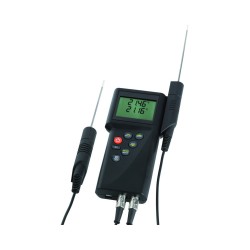
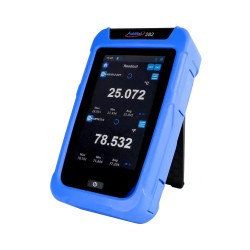
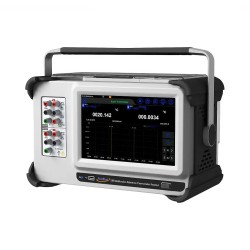
Our calibration thermometers are designed to offer maximum accuracy in temperature measurements. They are essential in numerous sectors and applications where temperature measurement is essential. Each model combines advanced technology with ease of use. Temperature calibration thermometers are ideal for validating processes, monitoring trends and making recordings. They can be coupled to sample thermocouples and thermoresistances.


Technical FAQ:
Thermometers for temperature calibration
What are temperature calibration thermometers?
Temperature calibration thermometers are high-accuracy digital thermometers, also called thermometer readout or bridge resistance thermometer, designed to read the signal coming from a sample probe with maximum precision. They combine low-noise measurement electronics with the ability to apply ITS-90 coefficients to the measured resistance.
What are thermometers used for temperature calibration?
In which sectors are thermometers most used for temperature calibration?
They are used in accredited metrological laboratories, in calibration services, in the pharmaceutical (GMP), food (HACCP), automotive, energy, oil & gas, aerospace, nuclear sectors and in all research and quality control contexts that require traceability of temperature measurements.
What types of calibration thermometers are there?
The main ones are PRT/SPRT readers (for high-accuracy platinum resistance thermometers), resistive bridge readouts (for primary use), multi-channel readers for RTDs and thermocouples and precision portable thermometers for field use. There are also combined models capable of reading PRTs, thermocouples and thermistors.
What is the difference between a reference and a process thermometer?
The reference thermometer has resolution up to 0.0001 °C, accuracy of the order of ±0.005/±0.01 °C, manages 4-wire connection and applies ITS-90 coefficients. A process thermometer typically has accuracies of ±0.1/±1 °C and is designed for ruggedness and direct value reading, not for calibration.
What resolution does a calibration thermometer offer?
Laboratory models offer resolutions up to 0.0001 °C (0.1 mK), high accuracy industrial models typically 0.001/0.01 °C. The resolution must be at least one order of magnitude better than the target calibration uncertainty, according to the 4:1 TAR ratio criterion.
Which sensors can a calibration thermometer read?
Typically PRT Pt25 and Pt100 (2, 3 or 4 wire), thermocouples (types K, J, T, N, R, S, B, E), NTC and PTC thermistors, primary SPRT sensors. The multi-channel models allow simultaneous reading of the sample probe and the probe being calibrated, eliminating temporal errors.
What does applying the ITS-90 coefficients mean?
It means converting the resistance measured by the sample probe into temperature by applying the specific coefficients of the probe (present on its calibration certificate) through the ITS-90 scale equations. Without this correction, using the Pt100 nominal curve introduces errors that can exceed 0.1 °C.
What excitation current does a precision thermometer use?
Typically currents of 1 mA or less for Pt100 probes, and 1 mA or less for Pt25. Too high a current generates self-heating of the probe with consequent measurement errors; High precision thermometers allow you to select the current or operate in AC mode to minimize its effects.
Which standards regulate calibration thermometers?
The main references are ISO/IEC 17025, IEC 60751 for industrial PRTs, IEC 60584 for thermocouples, the definitions of the ITS-90 scale and the EURAMET cg-8 guidelines for the calibration of thermometers.
How often should a calibration thermometer be calibrated?
The typical frequency is annual, but can be extended to 2 years depending on the conditions of use, the stability found and the requirements of the quality management system. It is good practice to carry out intermediate checks on the fixed points and linearity checks on the entire working range.
Can they also be used in the field or just in the laboratory?
There are laboratory models (high accuracy, mains powered, multi-channel) and portable, robust battery-powered models, suitable for field calibration of transmitters, process probes and data loggers. The choice depends on the required accuracy and the necessary mobility.