


Pressure transducers
Our pressure transducers are designed to deliver stability, accuracy and reliability in the most demanding industrial applications. Available for gauge, sealed gauge and absolute pressure, with analogue and digital outputs and wide measuring ranges, they integrate easily into hydraulic and pneumatic systems, test benches, automation systems and process monitoring, wherever continuous, fast and repeatable pressure measurement is required.

Technical FAQ:
Pressure transducers
What is a pressure transducer?
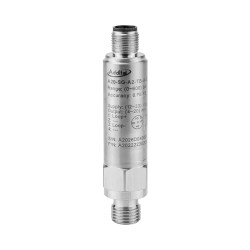
A pressure transducer is a sensor that converts the pressure of a fluid (liquid or gas) into a proportional electrical signal that can be used by PLCs, data acquisition systems and control units. It is the measuring element installed permanently on the process to detect pressure continuously.
What is a pressure transducer used for?
It is used to monitor and control pressure in hydraulic, pneumatic and process systems, passing the measured value to regulation, supervision and safety systems. It is also used on test benches and in testing applications, where a fast and repeatable measurement is required.
How does a pressure transducer work?
Pressure deforms a diaphragm on which the sensing element is built (typically piezoresistive or strain-gauge based). The resulting electrical change is amplified and conditioned by the built-in electronics, which compensate for temperature effects and provide an analogue or digital output signal proportional to the applied pressure.
What is the difference between a pressure transducer and a pressure transmitter?
Strictly speaking, a transducer provides a low-level signal (for example in mV/V), while a transmitter includes signal conditioning and delivers a standardised output (4-20 mA, 0-10 V or digital). In everyday use the two terms are often interchangeable, so it is always advisable to check the output type in the datasheet.
What output signals can a pressure transducer have?
The most common analogue outputs are 4-20 mA, ideal for long cable runs and noisy environments, and 0-10 V. Digital outputs include protocols such as RS485 Modbus-RTU and HART, which allow the sensor to be integrated into fieldbus networks and configured or calibrated remotely.
What is the difference between gauge, absolute and sealed gauge pressure?
Gauge pressure is measured relative to ambient atmospheric pressure; absolute pressure is measured relative to a perfect vacuum. In the sealed gauge version, the reference is instead sealed at the factory at a fixed pressure: this is a suitable solution for high measuring ranges and humid environments, where variations in atmospheric pressure are negligible.
How accurate is a pressure transducer?
Accuracy is expressed as a percentage of full scale (% F.S.) and includes the contributions of non-linearity, hysteresis and repeatability. For the same measuring range, a lower value means a measurement closer to the true value. It should also be checked over the whole operating temperature range, since thermal variations can affect the reading.
How do I choose the measuring range (full scale)?
The full scale should be chosen according to the maximum operating pressure, taking into account any peaks (water hammer, start-up transients) and the overpressure the sensor can withstand. A range that is too low makes the sensor work at its limit, while one that is too high reduces the useful resolution.
Which fluids and materials are compatible?
Compatibility depends on the material of the wetted parts (typically stainless steel) and on the process connection. Before choosing, check that the medium (air, water, hydraulic oils or aggressive fluids) and the system thread are compatible, by consulting the model's datasheet.
What is response time and why does it matter?
It indicates how quickly the signal follows a change in pressure and is decisive in dynamic measurements, such as peaks, pulsations and test benches. For the fastest applications, it is best to choose sensors with response times in the millisecond range.
How often should a pressure transducer be calibrated?
Like any measuring instrument, it should be checked periodically by comparing it with a more accurate reference, such as a digital pressure gauge or a pressure calibrator. The interval depends on how critical the application is and on the long-term stability of the transducer.
In which sectors and environments is a pressure transducer used?
It is used in hydraulics, test benches, industrial automation, oil & gas, energy and in all contexts that require continuous pressure monitoring. For harsh environments, it is important to choose models with good resistance to shock, vibration and repeated pressure cycles, as well as a wide operating temperature range.