


Clamp pressure calibrators
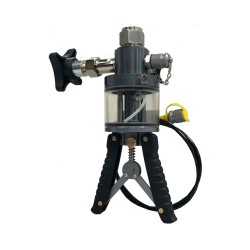
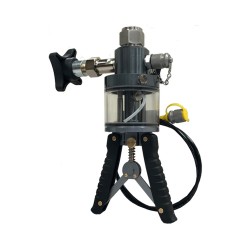
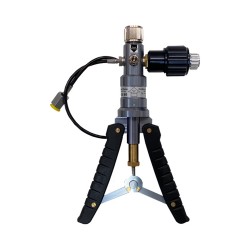
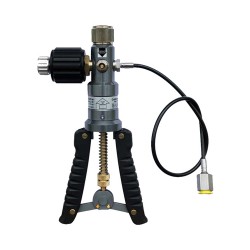
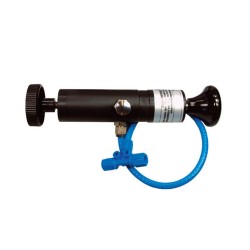
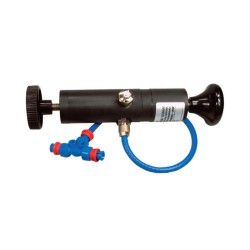
Our clamp pump pressure calibrators are essential tools for quick and accurate calibration of pressure systems. They are easy to use and extremely efficient, ideal for industrial environments where robustness and reliability are crucial; they offer a practical and fast solution, guarantee optimal control and stability of the pressure. This type of pressure calibrator is suitable for calibrating pressure gauges, pressure transducers, pressure switches and other measuring instruments.





Technical FAQ:
Clamp pressure calibrators
What is a clamp pressure calibrator?
A clamp pressure calibrator is a portable pressure-generating pump, operated by a "clamp" handle lever that is tightened with one hand. It combines compactness and fine pressure regulation, integrating pump, regulator and micrometric adjustment screw in a single body.
What is a clamp pressure calibrator for?
It is used to generate positive pressures (and in some models also vacuum) in a rapid and controlled manner for the field verification and calibration of pressure gauges, transmitters, pressure switches and other pressure measuring instruments. It is particularly appreciated for maintenance and diagnostic interventions.
In which sectors can a caliper pressure calibrator be used?
It is used in sectors such as industrial plant maintenance, oil & gas, chemical, HVAC, pharmaceutical, food, water treatment and in all contexts where it is necessary to calibrate pressure instruments directly in line without dismantling them.
How does a caliper pump work?
The user, by acting on the lever, compresses a small volume of air which generates the pressure applied at the outlet. A fine adjustment micrometric screw allows you to bring the value exactly to the desired set point, while a relief valve allows you to release the pressure in a controlled way.
What is the difference between a clamp pump and a pneumatic bench pump?
The clamp pump is designed for mobile use, is lightweight and can be operated with one hand. The benchtop pneumatic pump is bulkier, has greater stability and precision, and is suitable for fixed calibration stations in the workshop or laboratory.
What pressure range does a clamp calibrator cover?
The most popular models cover ranges up to approximately 20-40 bar in positive pressure, and from -0.85 to -0.95 bar in vacuum in combined pressure/vacuum models. There are also dedicated versions for lower ranges (mbar) for HVAC and low pressure applications.
Is a clamp pump suitable for positive pressure, vacuum or both?
There are models dedicated to positive pressure only, models for vacuum only and combined pressure/vacuum models. The choice depends on the type of instruments to be calibrated and the expected working range.
Which instruments can be calibrated with a clamp calibrator?
Analogue and digital pressure gauges, 4-20 mA or HART pressure transmitters, pressure switches, manoswitches and pressure indicators, combining them with a reference pressure gauge or a pressure calibrator with an external sensor.
What fluids can be used?
Clamp pumps use only clean air (or nitrogen in some applications). They are not suitable for hydraulic generation with oil or water: for high pressures or for hydraulic calibration hydraulic presses are used.
What are the advantages of a caliper pump compared to other systems?
Portability, lightness, possibility of use with just one hand (leaving the other free to manage the instrument or calibrator), speed of generation of
pressure and micrometric fine adjustment. The main disadvantage is the limited pressure range and lower accuracy compared to benchtop systems.
What accessories are needed to use it?
High pressure hoses, sets of adapters and fittings for the different threads (NPT, BSP, metric), possibly protection filters to avoid contamination in the reference instrument.
Is a caliper pump a measuring instrument?
No, the caliper pump is a pressure generator, not a measuring instrument. La pressione effettiva va sempre letta tramite un manometro di riferimento o un calibratore di pressione abbinato, che fornisce il valore vero di confronto con lo strumento in taratura.