


Benchtop pressure calibrators with primary weights
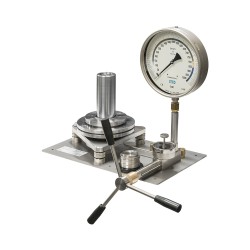
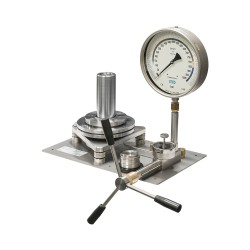
Primary weight bench type pressure calibrators are the ideal choice for those looking for calibration standards with maximum accuracy. They are specific calibrators for metrological laboratories, where the precision of measurements is crucial; each unit is designed to provide reliable and repeatable results, thanks to a system with tight tolerances. Pressure calibrators of this type are ideal for stringent requirements in terms of precision and reliability.

Technical FAQ:
Benchtop pressure calibrators with primary weights
What is a primary weighted bench pressure calibrator?
A primary weighted bench pressure calibrator is a primary measuring instrument, also known as a deadweight tester (DWT) or gauge balance, that generates reference pressure values by applying calibrated masses to a piston-cylinder system of known effective area. It leads the measurement directly back to the fundamental SI quantities - mass, length and gravity - constituting the top of the metrological traceability chain.
What is a primary weight bench pressure calibrator for?
It is used to calibrate other pressure measuring instruments with maximum accuracy: pressure gauges, transducers, transmitters, electronic calibrators and pressure switches. It is the reference instrument of accredited metrological laboratories for issuing calibration certificates with ACCREDIA traceability.
In which sectors is a benchtop pressure calibrator with primary weights used?
It is used in sectors where pressure measurement requires maximum accuracy: metrological laboratories and calibration centers, oil & gas, aerospace, pharmaceutical (GLP/GMP), automotive, chemical and petrochemical, production of measurement instruments and scientific research.
Why do we talk about "primary weights"?
What is the difference with a secondary instrument? A primary instrument directly realizes the measured quantity starting from its fundamental definition, without comparison with other pressure standards. A secondary instrument, on the other hand, must be periodically calibrated by comparison with a primary one and is subject to drift over time.
How does a primary weight pressure calibrator work?
The principle is based on the balance between the force generated by the pressure on the piston and the weight of the calibrated masses. During the measurement the piston is kept slowly rotating to minimize friction.
What types of primary weight pressure calibrators exist?
They are divided into pneumatic, which use gas (air or nitrogen) and cover low and medium ranges up to around 100-120 bar, and hydraulic, which use oil or water and reach much higher pressures, even over 1000-2500 bar. The choice depends on the working range and the fluid of the instruments to be calibrated.
What level of accuracy do you get with a primary weight calibrator?
Typical uncertainty is between 0.005% and 0.025% of reading, which is one to two orders of magnitude higher than the best electronic calibrators. This is why it is the reference instrument in the pressure traceability chain.
Which metrological corrections need to be applied during use?
To ensure accuracy, various corrections must be applied: local gravity, ambient temperature (which affects the effective area), air buoyancy on the masses, hydrostatic height difference (head correction) and fluid density. Dedicated software automates these calculations starting from the calibration certificate.
Which regulations and reference standards apply?
The main documents are the EURAMET cg-3 ("Calibration of Pressure Balances"), the ISO/IEC 17025 for calibration laboratories, the ACCREDIA guidelines and the OIML recommendations, which define procedures, uncertainty calculation and traceability requirements.
How often must it be recertified?
The recommended frequency is generally 2-5 years for the piston-cylinder system and up to 5 years for the mass set, depending on frequency of use, environmental conditions and quality management system. It is good practice to provide intermediate checks for comparison with a second sample.
What advantages does it offer compared to an electronic or automatic calibrator?
Compared to an automatic pressure calibrator, the primary weight bench pressure calibrator guarantees superior accuracy, practically unlimited stability over time, direct traceability to the SI and independence from the electronics and therefore from instrumental drift. On the other hand, it requires a slower measurement procedure and a qualified operator, and is therefore intended for use in the laboratory and not in the field.
What accessories does a complete station consist of?
A typical station includes a set of calibrated masses, interchangeable pistons and cylinders for the different ranges, pressure generation pump, fluid tank, set of adapters for connection to the instrument being calibrated, environmental thermometer and — optionally — dedicated software for calculating corrections and managing certificates.