


Industrial filter accessories for calibrators
Our industrial calibrator filters are designed to maximize device protection and cleanliness in harsh operating environments. These components are essential as they help maintain the cleanliness of the calibrators and reduce wear, prolonging their life. Suitable for a wide range of products and calibrators, our filters guarantee optimal and constant operation, essential for particularly dusty environments and in the presence of oil.
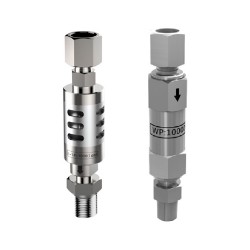

Technical FAQ:
Industrial filter accessories for calibrators
What are filters for industrial calibrators?
Filters for industrial calibrators are protective accessories installed between the process instrument to be calibrated and the pressure calibrator, with the function of retaining contaminants such as oil, humidity, solid particulates and process residues. They are equipped with replaceable filter elements in specific materials (sintered, coalescent, hydrophobic) selected based on the working fluid.
What are filters for industrial calibrators used for?
They serve to protect the internal sensors of pressure calibrators and reference pressure gauges from contamination of the process fluid, prolonging their useful life, maintaining the declared accuracy and avoiding early cleaning or recalibration interventions.
In which sectors can filters for industrial calibrators be used?
They are used in oil & gas, refineries, petrochemical, chemical, pharmaceutical, food, energy, water treatment, paper mills and in any context in which the instrument to be calibrated contains dirty, oily, humid or aggressive fluids that could damage the reference calibrator.
What types of filters are there for pressure calibrators?
There are particulate filters (for solid residues and dirt), coalescent filters (for oil/air separation), hydrophobic filters (for moisture protection), multi-stage combination filters and inertial separators for high pressure applications. The choice depends on the type of contamination expected in the process fluid.
How do you choose the right filter for your application?
The choice is based on four parameters: type of fluid (gas, oil, steam, mixed fluids), maximum working pressure, degree of filtration required (typically from 0.1 to 40 μm) and type of connection thread. For high pressures or corrosive fluids, stainless steel filter body and compatible gaskets must be used.
What types of contaminants can damage a calibrator?
The main ones are solid particulates (rust, scale, dust), oil and oil vapors from compression systems, humidity and condensation, process residues (hydrocarbons, solvents), metal wear particles and chemical residues. Even small quantities can block the internal channels of the sensor or alter the sensitive membrane.
Which filtration level (micron) should you choose?
For general applications, 5-10 μm filters are used; for the protection of high accuracy sensors it drops to 1-2 μm; for metrology laboratories or high precision calibrators it reaches 0.1-0.5 μm. However, a degree of filtration that is too fine can increase the pressure drop and slow down the stabilization of the pressure during calibration.
How often should the filter element be replaced?
The frequency depends on the degree of contamination of the fluid and the frequency of use. In standard conditions the replacement is semi-annual or annual; in harsh environments (oil & gas, maintenance of old systems) it may be necessary every 50-100 hours of work. A sudden increase in pressure drop is a clear indicator of a saturated filter.
Do filters introduce errors in pressure measurement?
A clean and correctly sized filter does not introduce significant errors when fully operational, but it can slow down stabilization (dead time). A clogged filter, on the other hand, generates pressure drops which alter the pressure applied to the sensor, distorting the reading. In-depth analysis: Measurement errors in the process.
Are the filters compatible with all pressure calibrators?
Compatibility depends on the connection thread (1/8" NPT, 1/4" NPT, BSP, metric) and the maximum working pressure. The adapter sets allow you to integrate the filters with any calibrator or pump, regardless of the manufacturer.
Can they be used with hydraulic pumps and presses?
Yes, there are specific filters for hydraulic applications, designed to withstand the high pressures of hydraulic presses (up to 1000-2500 bar) and compatible with mineral and synthetic oils. They are essential to protect the reference pressure gauge from residues present in the instrument being calibrated.
Are they mandatory or optional accessories?
Technically they are optional, but they become practically indispensable when working on real process plants, where contamination is always present. The investment in filters pays for itself with increased calibrator life, calibration stability and the elimination of costly sensor repairs.