


Set of adapters for pumps and presses
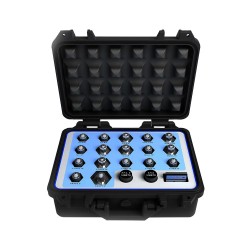
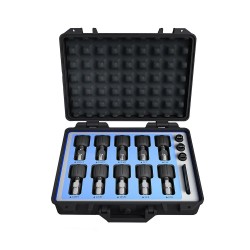
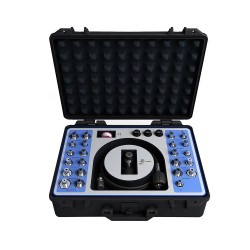
Our adapter sets are CNC manufactured to provide maximum sealing and preserve the life of the threads. Available in many configurations, they are suitable for use and use on the entire range of pressure gauges, pressure sensors, transmitters, pressure switches and much more. Available individually or in convenient case kits to always be ready for any eventuality.

Technical FAQ:
Set of adapters for pumps and presses
What is a set of adapters for pumps and presses?
It is a case or kit containing an assortment of fittings, reducers, extensions and adapters in various materials and threads, designed to quickly and securely connect the instruments to be calibrated to pneumatic pumps, caliper calibrators and hydraulic presses, regardless of the native thread of the device.
What are the sets of adapters for pumps and presses used for?
They serve to solve the problem of incompatibility between the threads of the different process instruments: NPT, BSP/G, metric, JIC, SAE often coexist on the same system. A complete set allows the technician to tackle any calibration in the field without having to purchase individual fittings from time to time.
In which sectors can the sets of adapters for pumps and presses be used?
They are used in all sectors in which the calibration of pressure instruments is performed: oil & gas, petrochemical, chemical, pharmaceutical, food, automotive, energy, naval, aerospace, water treatment and in calibration service laboratories, where the variety of incoming instruments requires maximum connection flexibility.
What threads are included in a standard adapter set?
A complete set typically includes NPT (1/8", 1/4", 3/8", 1/2"), BSP/G (1/8", 1/4", 3/8", 1/2") threads, metric threads (M10, M12, M14, M16, M20), in some cases also JIC (37°) and SAE (45°). They can be male/male, male/female or double female.
What is the difference between NPT, BSP and metric threads?
NPT (National Pipe Thread) are American tapered threads that seal the thread; BSP/G (British Standard Pipe) are English and are divided into conical (BSPT) and cylindrical (BSPP/G), with gasket sealing; the metrics follow ISO 261 and are widespread in Europe and Asia. They are not interchangeable and require specific adapters.
What materials are the adapters made of?
The most common are AISI 316 stainless steel (universal chemical compatibility, resistance to corrosion and high pressure), nickel-plated brass (for standard low-medium pressure applications), and in some cases carbon steel or special alloys for specific applications. For pharmaceutical and food applications, stainless steel is preferred.
What are the maximum operating pressures of the adapters?
It depends on the material, geometry and thread: brass adapters typically reach 250-400 bar, stainless steel ones at 700-1000 bar or more, while those for high pressure hydraulic presses are certified up to 2500-4000 bar. It is essential to check the pressure class before use.
How is the seal between adapter and instrument guaranteed?
Tapered threads (NPT, BSPT) seal directly on the thread, but it is good practice to apply PTFE sealant or tape. Cylindrical threads (BSPP/G, metric) require flat gaskets made of copper, aluminum, fiber or O-rings in materials compatible with the process fluid (FKM, EPDM, NBR, PTFE).
Is an adapter set compatible with any calibrator or pump?
Yes, generic sets are designed to be compatible with any brand of pneumatic pump, caliper calibrator or hydraulic press. Only the pump side threads need to be checked, generally standardized to 1/4" BSP or 1/4" NPT.
What complementary accessories are useful in addition to adapters?
In addition to adapters, high pressure hoses (in reinforced PTFE or stainless steel), protection filters, breather and isolation valves, reference pressure gauges, spare seals and - for hydraulic applications - cans and syringes for topping up oil are useful.
How do you store and maintain a set of adapters?
They should be stored clean and dry in the original case, avoiding contact with dust and humidity. The threads must be periodically checked for signs of wear or dents; gaskets and O-rings must be replaced regularly. Adapters used on dirty fluids should be cleaned thoroughly before storage.
Can the adapters also be used for vacuum applications?
Yes, stainless steel adapters are also suitable for vacuum operations, but the quality of the seals is essential: O-rings in FKM or PTFE guarantee vacuum sealing, while PTFE tape on the conical threads is less reliable. For applications with high vacuum it is preferable to use dedicated VCR or KF connections.