


Hydraulic presses
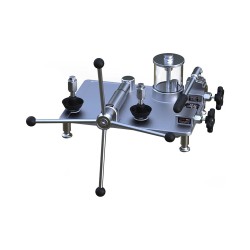
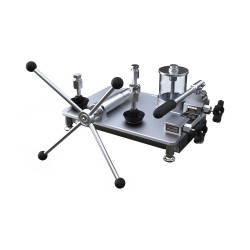
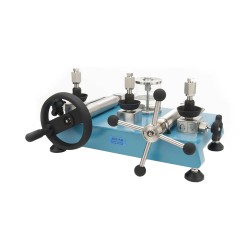
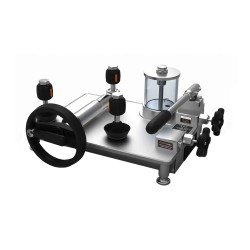
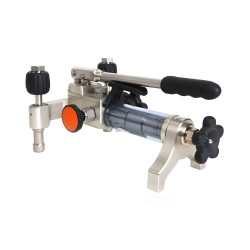
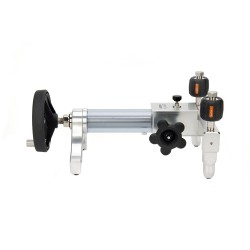
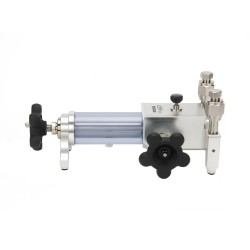
Our hydraulic pressure calibration presses are designed to offer maximum precision and stability at high pressures. These robust and reliable instruments guarantee accurate calibration. They are essential for testing and calibrating a wide range of instruments and sensors: pressure gauges, transmitters, transducers, pressure switches. Thanks to the engineering studies with which they were designed, they exploit levers that facilitate generation, without requiring considerable physical effort from the operator.

Technical FAQ:
Hydraulic presses
What is a hydraulic test pump?
A hydraulic test pump is a manual pressure generation device that uses an incompressible fluid—typically hydraulic oil, and sometimes distilled water—to generate high pressures through a screw-and-piston mechanism. It is a standard tool for hydraulic pressure generation in both field and laboratory calibration applications.
What is a hydraulic test pump used for?
It is used to generate high pressures, often reaching several thousand bar, in a controlled and repeatable manner for the testing and calibration of pressure gauges, pressure transmitters, and pressure switches used in hydraulic systems. It is typically used together with a reference gauge or pressure calibrator to determine the true pressure value.
How does a hydraulic test pump work?
A micrometric screw drives a piston inside a chamber filled with hydraulic fluid, compressing the fluid and generating pressure at the output port. A pre-fill pump allows rapid filling of the circuit, while the screw mechanism provides fine adjustment to reach the desired pressure setpoint.
What is a hydraulic test pump used for, and in which industries?
Hydraulic test pumps are widely used in oil & gas, industrial hydraulics, fluid power systems, automotive brake testing, aerospace, power generation, marine applications, and any environment where high-pressure calibration is required. They are standard tools for maintenance technicians and calibration laboratories.
What pressure range can a hydraulic test pump generate?
Common models cover pressure ranges from 0 to 700, 1,000, 1,600, 2,500, or even 4,000–6,000 bar, depending on the manufacturer and piston design. Specialized models can exceed 10,000 bar for ultra-high-pressure applications.
Which fluids are used in a hydraulic test pump?
Hydraulic mineral oil (such as ISO VG 32 or equivalent) is most commonly used. In specific applications, distilled water may also be employed. The choice of fluid depends on compatibility with the instrument being calibrated. To avoid contamination, it is often recommended to use the same fluid as the target process system.
What is the difference between a hydraulic test pump and a pneumatic pressure pump?
A hydraulic test pump uses an incompressible fluid such as oil and can generate extremely high pressures, often reaching several thousand bar. A pneumatic pump uses a compressible gas, such as air or nitrogen, and typically operates up to only a few tens of bar. The choice depends on the required pressure range and the process medium of the instrument under test.
Which instruments can be calibrated using a hydraulic test pump?
Hydraulic test pumps can be used to calibrate high-pressure analog and digital pressure gauges, pressure transmitters, pressure switches, safety relief valves, hydraulic system sensors, and other instrumentation used in hydraulic applications. They should always be used together with a reference pressure gauge or pressure calibrator.
Which accessories are required?
Typical accessories include adapter and fitting kits for various thread types (NPT, BSP, metric, JIC), oil reservoirs, vent and isolation valves, contamination protection filters, and a reference pressure gauge or calibrator for accurate pressure measurement.
Is a hydraulic test pump a measuring instrument?
No. A hydraulic test pump is a pressure generation device, not a pressure measuring instrument. It generates and controls pressure but does not determine the actual pressure value. The accuracy of the calibration depends entirely on the reference gauge or calibrator connected to the system.
How is a calibration performed using a hydraulic test pump?
The instrument under test and the reference pressure instrument are connected to the pump outputs. Air is removed from the circuit through the vent valve—a critical step to avoid measurement errors. The desired pressure setpoints are then generated using the micrometric screw, and the readings from both instruments are compared to determine any deviation.
How accurate is the pressure generated by a hydraulic test pump?
The hydraulic test pump itself does not have a specified measurement accuracy because its role is only to generate pressure. Calibration accuracy is determined by the reference instrument used for measurement, typically a high-accuracy digital pressure gauge or an advanced pressure calibrator with accuracy ranging from 0.01% to 0.05% of full scale.