


External sensor pressure calibrators
Pressure Calibrators External Sensors offer flexible and versatile solutions for a variety of industrial and laboratory applications. These devices are designed to accompany the calibrators: to easily integrate with existing systems, providing high precision and reliability measurements. Ideal for various contexts, where adaptability and accuracy are required. Our external sensors ensure flawless calibration and are compatible with a wide range of measuring instruments.

Technical FAQ:
External sensor pressure calibrators
What are external pressure sensor calibrators?
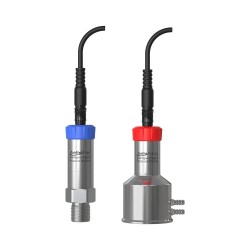
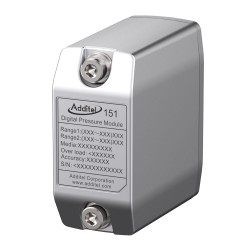
External pressure sensor calibrators are modular pressure calibration systems in which the measurement sensor is not integrated into the instrument body but housed in an interchangeable external module connected to the base unit through a digital interface. Each module contains its own internal memory with calibration data and metrological information.
What are external pressure sensor calibrators used for?
They are used to extend the operating range of a single base calibrator by utilizing different pressure modules, including low, medium, and high pressure, as well as absolute, differential, and vacuum measurements. They also allow only the specific module to be replaced or sent for calibration, while keeping the rest of the system operational.
In which industries can external pressure sensor calibrators be used?
They are widely used in metrology laboratories, calibration service centers, industrial maintenance, oil & gas, pharmaceutical, food processing, energy, and any application requiring a flexible calibration system capable of covering multiple pressure ranges with a single control unit.
How does an external pressure sensor work?
The module contains a high-accuracy pressure transducer, signal conditioning electronics, and internal memory storing calibration coefficients. When connected to the base unit, the calibrator automatically recognizes the module, loads its calibration data, and configures it as a measurement channel.
What is the difference between a calibrator with an integrated sensor and one with an external sensor?
An integrated sensor is physically built into the calibrator, with a fixed pressure range and calibration linked to the entire instrument. An external sensor is modular, replaceable, and can be recalibrated independently. This provides greater flexibility and reduces downtime, since only the sensor module needs to be sent for calibration.
What pressure ranges can external sensors cover?
The available range is extremely broad, from just a few millibars—including differential measurements for low-flow applications—up to 2,000 bar or more in high-pressure models. Modules are available for absolute, gauge, differential, and vacuum pressure measurements.
Are external sensors interchangeable between different calibrator models?
In general, sensor modules are compatible within the same product family from a specific manufacturer. Compatibility between different brands is not guaranteed. It is always recommended to verify the communication protocol (digital, ISA, USB, etc.) as well as electrical and mechanical compatibility.
What are the advantages of external sensors compared to integrated sensors?
External sensors offer greater flexibility, allowing a single calibrator to cover multiple pressure ranges. They reduce calibration costs because only the module needs to be recalibrated, improve operational continuity, enable system upgrades with additional modules, and optimize measurement accuracy for each pressure range.
Do external sensors retain their own calibration data?
Yes. Each module is an intelligent device that contains internal memory storing calibration coefficients, serial number, calibration date, and certificate information. When connected to a base unit, this data is automatically read, ensuring the metrological integrity of the system.
Can external sensors be used for gauge, absolute, and differential pressure?
Yes. Dedicated modules are available for gauge pressure, absolute pressure, differential pressure, bidirectional pressure, and vacuum applications. Some advanced models can even be configured via software to operate in different measurement modes.
How often should external sensors be calibrated?
The typical calibration interval is one year, although it may be extended to two years depending on operating conditions, sensor stability, and the requirements of the quality management system (such as ISO/IEC 17025). The main advantage of a modular system is that only the individual sensor module needs to be recalibrated.
What types of connections do external sensors use?
The most common interfaces include proprietary digital connections, USB, RS-485, and ISA-based protocols. Digital data transmission eliminates analog-to-digital conversion errors and prevents drift caused by cable-related signal degradation.