


Multi-parameter transmitters and sensors
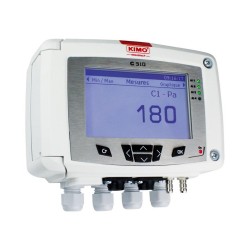
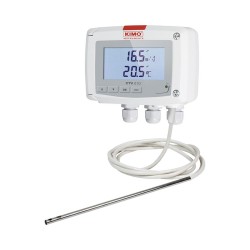
Our multi-parameter transmitters and sensors offer an advanced solution for simultaneously monitoring various parameters such as temperature, pressure, humidity and more. These devices are easy to install and configure, provide continuous monitoring and are built to withstand the most demanding environments. Thanks to their 4-20mA or 0-10V analog output they can be easily integrated with the process.

Technical FAQ:
Multi-parameter transmitters and sensors
What is a multi-parameter transmitter or sensor?
It is an industrial device that integrates multiple sensors in a single body, capable of simultaneously measuring multiple process variables (e.g. temperature + humidity, pressure + temperature, mass flow + temperature + density in Coriolis units).
What is a multi-parameter transmitter or sensor used for?
It is used to reduce the number of installations, wiring and inputs to the DCS/PLC, optimizing space and costs, and to provide correlated measurements in a single physical point, improving process control thanks to the spatial and temporal consistency of measurements.
In which sectors is a multi-parameter transmitter or sensor used?
It is used in HVAC (T + RH + CO₂), oil & gas and custody transfer (flow + T + P + density with Coriolis), water treatment (pH + conductivity + dissolved oxygen), pharmaceutical and food industry, energy management (V + I + cos φ + energy with analyzers), automotive and meteorology.
When to choose a multi-parameter transmitter instead of a single-parameter one?
The multi-parameter is chosen when the variables are physically correlated (same measurement area), when reducing wiring and installation holes is desired, when optimizing the cost per measurement point. The single-parameter is preferable for maximum accuracy on a specific variable and for greater redundancy.
Which multi-parameter combinations are most common?
T + RH (HVAC, regulated environments); T + RH + CO₂ (indoor air quality); T + P (technical gases); P + Δp + T (derived flow measurement); flow + T + density (Coriolis for custody transfer); V + I + φ + energy (network analyzers).
Are multi-parameter transmitters or sensors more or less accurate than singleparameter ones?
For most applications, accuracy is equivalent or only slightly lower than that of the single-parameter. In very high precision applications (custody transfer, metrology), dedicated single-parameter units are still preferred.
Do multi-parameter transmitters or sensors have a single output or multiple outputs?
The most widespread models have a digital output (HART, Modbus, Profibus, FOUNDATION Fieldbus) that transmits all variables on a single bus, optimizing wiring. Some models also offer multiple 4-20 mA analog outputs dedicated to each variable.
Can the output variables be configured with a multi-parameter sensor or transmitter?
Yes, via HART communicator or configuration software, you can select which variables (primary variable PV, secondary SV, tertiary TV, quaternary QV) to transmit via 4-20 mA or bus, in addition to setting range, damping and alarm thresholds.
What is a "derived variable" in a multi-parameter?
It is a variable calculated internally by the transmitter from primary measurements. Examples: mass flow calculated from volumetric flow + density; temperaturecompensated differential pressure; flow rate corrected as a function of T and P for gas. It reduces the calculation load on the DCS.
Are multi-parameter transmitters or sensors ATEX and SIL certifiable?
Yes, industrial versions are available with ATEX/IECEx Ex ia/d certifications for explosive atmospheres and SIL 2/3 for functional safety applications, with the same requirements provided for single-parameter units.
Do multi-parameter transmitters or sensors need to be calibrated on each channel?
Yes, each measured quantity must be calibrated independently with its own reference (pressure calibrator, temperature calibrator) and with its own calibration intervals. The final certificate reports the calibrated points and uncertainties for each variable.
Are multi-parameter units more economical than multiple equivalent singleparameter units?
The unit cost is higher than a single-parameter, but generally lower than the sum of multiple equivalent single-parameter units, also considering the savings on wiring, housings, installation and maintenance.