


Current clamps
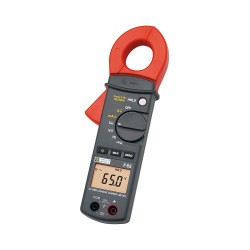
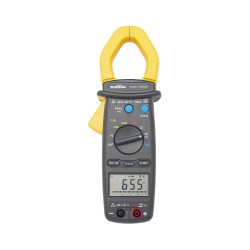
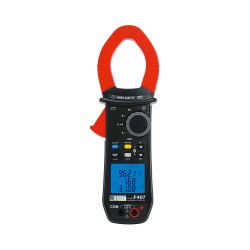
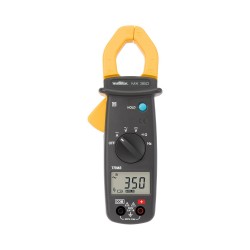
Our current clamps are essential tools for electricians who need to measure current in circuits without interrupting the flow or touching the conductors directly, ensuring safety and precision. These calipers are perfect for work in domestic, commercial and industrial environments, allowing you to detect overloads and efficiency problems in a non-invasive way.


Technical FAQ:
Current clamps
What is a clamp meter?
It is an electrical current measuring instrument designed to measure non-invasively, by clamping one of the conductors with the openable clamp without interrupting the circuit or removing wiring. It exploits the principle of electromagnetic induction (for AC) or the Hall effect (for AC/DC).
What is a clamp meter used for?
It is used to measure the current absorbed by motors, panels, feeders and individual circuits without interrupting the power supply, perform diagnostics of unbalanced or abnormal loads, measure high currents (even over 1000 A) not manageable with a traditional multimeter.
In which sectors is a clamp meter used?
It is used in industrial, civil, tertiary maintenance, automotive, HVAC, photovoltaic, naval sector, motor and drive troubleshooting, electrical panel inspection, energy audits and anomalous consumption diagnostics.
What is the difference between a clamp meter and an electrical multimeter?
The clamp meter measures current without contact by clamping the cable, and it is optimal for high currents and non-interruptible circuits. The multimeter measures current in series via probes, with higher accuracy but limited to 10-20 A. Modern models are often "clamp multimeters" that integrate both functions.
AC, AC/DC or Rogowski flexible clamps: what are the differences?
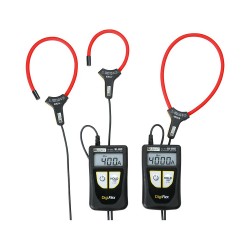
AC clamps (based on current transformer): measure only alternating current, economical and widespread. AC/DC clamps (with Hall sensor): measure both AC and DC, indispensable for photovoltaic and DC drives. Flexible Rogowski clamps: wrappable around large or irregularly shaped conductors, ideal for high currents (>1000 A) and congested panels.
What are the typical ranges of a clamp meter?
Generic models measure up to 400-600 A; industrial ones up to 1000-2000 A; flexible Rogowski clamps reach 3000-6000 A. Typical resolution ranges from 0.01 A in models for low currents to 1 A in high-range models.
What does a modern clamp meter measure besides current?
Multifunction clamps integrate: DC/AC voltage, resistance, continuity, diode test, frequency, capacitance, temperature, active/reactive/apparent power and power factor (wattmeter models), inrush current (motor starting current), True RMS, Bluetooth and logging.
What does Inrush Current mean?
It is the starting current absorbed by a motor or transformer at start-up, typically 5-10 times the nominal current for a few seconds. The inrush capture function of professional clamps allows it to be detected with short integration times (100 ms),
useful for sizing protections and cables.
Which safety categories must clamp meters have?
For industrial use, at least CAT III 600 V or CAT IV 600 V is required; for measurements on distribution panels and MV lines, CAT IV 1000 V is required. The category is indicated on the clamp itself and on the probes (always check the consistency between clamp and accessories).
Can clamp meters be used on insulated conductors without disconnecting them?
Yes, this is the main advantage: the clamp measures the magnetic field generated by the current without electrical contact with the conductor, so it operates safely on energized insulated cables. However, it is essential to clamp around one conductor at a time (phase or neutral), not the entire multipolar cable which would give a zero measurement.
Are there ATEX clamps for classified zones?
Yes, there are clamps certified ATEX/IECEx Ex ia for use in explosive atmospheres (Zone 1, 2), indispensable in oil & gas, refineries, chemicals. They have range limitations and specific accessories to ensure intrinsic safety.
Do clamp meters need periodic calibration?
Yes, typical interval is annual for inspection use or compliance with quality systems (ISO/IEC 17025), biennial for general use. Calibration includes verification of linearity across the entire range and accuracy on nominal current values.