


Single gas detectors
Our single gas detectors are designed to offer precise and reliable detection of specific hazardous gases; they are compact and easy to use and are essential for personal safety in confined or at-risk environments. Each detector is optimized to quickly and accurately identify specific gas concentrations, providing timely alerts to safeguard operators on the job.

Technical FAQ:
Single gas detectors
What is a single-gas detector?
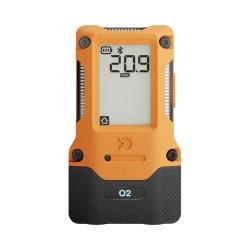
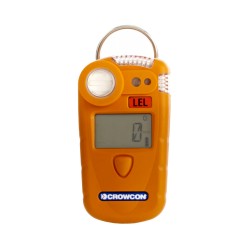
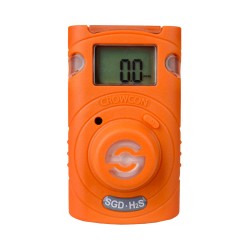
A single-gas detector is a device designed to measure only one specific gas, typically CO (carbon monoxide), H₂S (hydrogen sulfide), O₂ (oxygen), NH₃ (ammonia), Cl₂ (chlorine), SO₂, or others. Compact and pager-sized, it is intended for personal protection in situations where the risk is linked to a single known substance.
What is a single-gas detector used for?
It is used to protect workers from exposure to a single hazardous gas in the workplace by continuously monitoring its concentration in real time and triggering alarms when TWA (8-hour), STEL (15-minute), or instantaneous thresholds are exceeded. It is the standard personal safety device in environments with well-defined single-gas risks.
In which industries are single-gas detectors used?
They are used in wastewater treatment plants and sewage systems (H₂S), underground parking garages (CO), paper industry (Cl₂), refrigeration and livestock sectors (NH₃), water treatment facilities (Cl₂, O₃), welding and metal processing (CO, O₃), indoor environments (CO, CO₂), and confined space operations where oxygen verification is required.
When should a single-gas detector be chosen instead of a multi-gas detector?
A single-gas detector is chosen when the risk is specific and clearly linked to one substance, when a lightweight and long-lasting personal protection device is required, or as a secondary device alongside a multi-gas detector for enhanced sensitivity to a specific hazard (e.g., a sewer worker wearing a standard multi-gas detector plus an H₂S single-gas detector).
What are the most commonly monitored gases in single-gas detectors?
The most common gases include CO (parking areas, garages, fire services), H₂S (oil & gas, sewage systems, confined spaces), O₂ (pre-entry confined space checks), NH₃ (industrial refrigeration and livestock), Cl₂ (water treatment plants, swimming pools), SO₂ (paper industry, refineries), and HCN (electroplating, fire smoke exposure).
What sensor technology is used in single-gas detectors?
The standard technology is the electrochemical sensor, which generates a current proportional to gas concentration through a controlled redox reaction. It is compact, selective, and low-power, making it ideal for toxic gases at ppm levels. Oxygen detection typically uses galvanic electrochemical cells, and in some cases fuel-cell sensors are also used.
What is the battery life of a single-gas detector?
Disposable single-gas detectors have a lifetime of 2–3 years, with sealed sensor and battery requiring no maintenance. Rechargeable models offer continuous operating autonomy of 12–30 months, using lithium batteries that can be recharged or replaced.
What are “disposable” single-gas detectors?
Disposable single-gas detectors are sealed devices with integrated sensor and battery, designed to operate continuously for 2 to 3 years, after which they are disposed of. They require no recharging or component replacement—only periodic bump tests. They are widely used in industries where exposure risk is continuous and personal, such as H₂S monitoring in refineries.
What are the standard exposure limits?
Typical limits (ACGIH TLV and Italian Legislative Decree 81/2008): CO: TWA 25 ppm, STEL 50 ppm, H₂S: TWA 10 ppm, STEL 15 ppm, NH₃: TWA 25 ppm, STEL 35 ppm, Cl₂: TWA 0.5 ppm, STEL 1 ppm, SO₂: TWA 2 ppm, STEL 5 ppm, O₂: safe range 19.5–23.5%.
How is a bump test performed on a single-gas detector?
A known gas concentration (calibration gas cylinder) is applied to the sensor using a test cap or automatic docking station. The device response is verified by checking that the measured value matches the applied gas and that alarms activate correctly. The procedure is typically performed daily or before each use, according to EN 60079-29-2.
Are single-gas detectors ATEX certified?
Yes. All professional single-gas detectors are ATEX/IECEx certified with intrinsic safety (Ex ia), typically classified as Ex ia IIC T4 or T3. They are suitable for use in hazardous areas classified as Zone 0 (continuous presence) or Zone 1/2 (occasional presence).
Can they be used together with multi-gas detectors?
Yes, this is a common practice in high-risk applications. Workers often wear a standard multi-gas detector (O₂/LEL/CO/H₂S) alongside a single-gas detector dedicated to a specific hazard (e.g., HCN for firefighters or Cl₂ in wastewater treatment plants). This provides redundancy and higher sensitivity for the target gas.