


Electrical safety
Our electrical safety solutions are essential to protect people and facilities from the risks associated with electrical installations. We offer a wide range of devices designed to detect anomalies, prevent accidents and ensure compliance with current regulations. These include safety switches, voltage detectors, surge protectors and other continuous monitoring systems.

Technical FAQ:
Electrical safety
What is meant by electrical safety solutions?
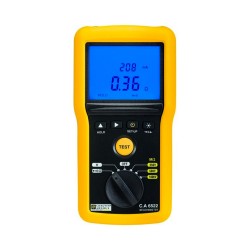
Electrical safety solutions refer to the set of instruments dedicated to verifying the compliance of electrical installations with safety standards (CEI 64-8, CEI 11-27, CEI EN 61557): insulation testers, PE continuity meters, RCD/differential test instruments,
fault loop impedance meters, multifunction instruments for periodic verifications.
What electrical safety solutions does E Instruments offer?
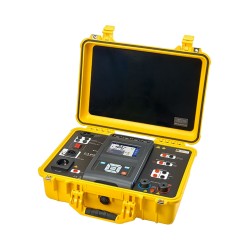
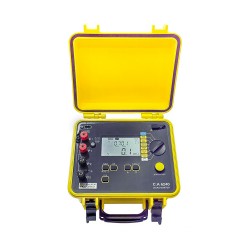
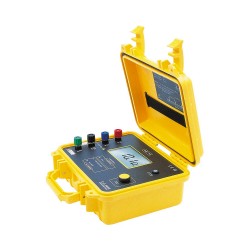
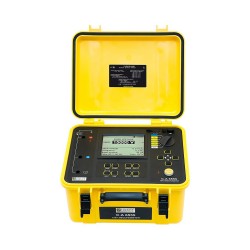
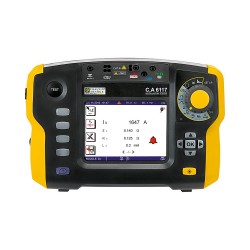
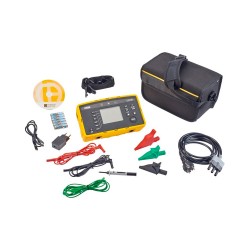
The range includes multifunction testers for complete CEI 64-8 verifications, megohmmeters for insulation measurements, RCD measurement instruments (sensitivity, intervention time), fault loop meters (Zs, Ipfc), earth meters and instruments for verifying protection coordination.
In which sectors are electrical safety instruments used?
They are used by electrical installers and maintenance technicians, sector professionals (surveyors, engineers), inspection bodies, large industries (oil & gas, food, pharmaceutical), tertiary (offices, hospitals, hotels, schools) and in all initial and periodic verification activities of electrical installations.
What are the mandatory verifications on an electrical installation?
According to CEI 64-8/6: continuity test of the protective conductor (PE), insulation resistance measurement, verification of circuit separation, fault loop impedance measurement, residual current device (RCD) test, verification of protection coordination and functional tests.
What is the insulation test and at what voltage is it performed?
It is the measurement of resistance between active and protective parts, performed with a megohmmeter that applies a DC test voltage (250 V, 500 V, 1000 V, 2500 V or 5000 V based on the nominal voltage of the circuit). For LV circuits up to 500 V, 500 V is applied with a minimum required value of 1 MΩ.
What is the Zs measurement (fault loop impedance)?
It is the measurement of the total impedance of the fault circuit to earth (phase + PE + source), from which the prospective short-circuit current Ipfc is calculated and coordination with magnetothermic protections is verified. It is fundamental to ensure protection opening within the prescribed times.
How is a differential (RCD) verified?
Real sensitivity is measured (actual intervention current, must be between 50% and 100% of IΔn), intervention time (for general RCDs ≤300 ms, for instantaneous ones <40 ms at 5×IΔn) and the resulting contact voltage is also verified. They are mandatory parameters for installation certification.
Which regulations govern electrical safety in Italy?
The main ones are CEI 64-8 (LV electrical installations, transposing HD 60364), CEI 11-27 (electrical work, PES/PAV/PEI qualifications), CEI EN 61557 (safety test equipment), D.Lgs. 81/2008 (workplace safety, Italian transposition of EU Framework Directive 89/391/EEC), DM 37/08 (insta
What are PES, PAV and PEI?
They are qualifications provided by CEI 11-27 for personnel performing electrical work: PES (Expert Person) for live and dead work on MV/HV systems; PAV (Warned Person) for simple work under supervision; PEI (Suitable Person) specific qualification for live work. The appointment is formal and documented by the employer.
What is a multifunction tester for installations?
It is an instrument that integrates all the functions necessary for CEI 64-8 verifications in a single device: insulation test, continuity, Zs, RCD, phase sequence, voltage, earth measurement. It drastically reduces verification times and standardizes the test procedure, with direct printing of compliant reports.
Can photovoltaic installations also be tested?
Yes, there are multifunction testers specific for photovoltaic installations that measure: open-circuit DC voltage (Voc), short-circuit current (Isc), DC insulation resistance, I-V curve of the field, solar irradiation, module temperature, tests on interface devices according to CEI 0-21 and CEI 82-25.
Do electrical safety instruments need periodic calibration?
Yes, CEI 11-27 and quality systems (ISO/IEC 17025) require annual calibration of instruments used for declarations of conformity or inspection verifications. The calibration certificate must be attached to the verification documentation.