


Pressure transducers
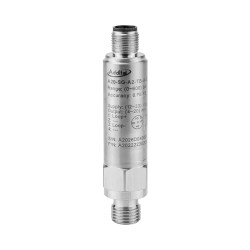
Our pressure transducers for process measurement are sensors that continuously detect the pressure of liquids and gases directly on the plant and pass it on to PLCs, controllers and supervision systems. The range includes pressure sensors with analogue and digital outputs, for gauge, sealed gauge and absolute pressure, designed for permanent installation in hydraulic, pneumatic and automation systems, even in the presence of shock, vibration and temperature swings.

Technical FAQ:
Pressure transducers
How do I choose a pressure sensor for a plant?
Start with the type of pressure to be measured (gauge, absolute or differential), the measuring range and the fluid. Then check the operating temperature, the type of output required by the control system and the environmental conditions: shock, vibration, humidity and dust. Comparing options within the range of transmitters and sensors helps identify the most suitable solution.
Which output should I choose: 4-20 mA, 0-10 V or digital?
4-20 mA is the traditional choice for long cable runs and electrically noisy environments, because current is not affected by voltage drop along the line. 0-10 V is suited to short connections and to the analogue inputs of simpler systems. Digital outputs, such as RS485 Modbus-RTU, make it possible to read more data and to configure the sensor remotely.
How is a pressure sensor installed correctly?
The sensor must be fitted to a connection that is compatible with the process, with seals suited to the fluid and without forcing the thread. The position should avoid air pockets or deposits in front of the diaphragm, and the tapping point should be away from turbulence. For cables, it is advisable to use shielding that is correctly connected, to reduce interference.
What is overpressure and why is it important?
It is the maximum pressure the sensor can withstand without permanent damage, and it lies beyond the nominal measuring range. In applications with peaks, such as water hammer or pump start-ups, it is important that the permitted overpressure is significantly higher than the maximum foreseeable pressure.
How can sensors be protected from pressure peaks and pulsations?
Snubbers or restrictors can be used at the tapping point, or a suitable measuring range can be chosen. This limits stress on the diaphragm and gives a more stable signal, avoiding unstable readings in circuits with piston pumps or fast-closing valves.
How does temperature affect the measurement?
The temperature of the fluid and of the environment can cause the signal to vary. Industrial sensors compensate for the thermal effect within a declared operating range: beyond that range, the error may increase. Both the process temperature and the temperature of the environment in which the electronics are installed must therefore be checked.
What does long-term stability (drift) of a sensor mean?
Drift is the slow variation of the signal at constant pressure, caused by ageing and working cycles. A stable sensor maintains its performance for longer and requires less frequent checks: this is a decisive criterion for installations that are difficult to reach.
How is a pressure sensor connected to a PLC?
A sensor with an analogue output is connected to a dedicated PLC input, with the scale set in engineering units (bar, psi). With digital outputs such as Modbus-RTU, the PLC reads the values over a serial bus, even from several sensors on the same line. Before connecting, check the power supply required by the sensor.
How is an already installed pressure sensor checked?
Its reading is compared with a more accurate reference connected at the same tapping point, such as a pressure calibrator. In many cases the check is carried out in the field, without removing the sensor from the plant.
What degree of protection is needed in dusty or damp environments?
The IP rating indicates resistance to dust and liquids. For industrial environments with washdowns or splashing, a high rating is advisable, while for installation inside a cabinet lower protection is enough. The type of connector or cable outlet should also be checked, since it can limit the protection of the whole assembly.
What are industrial pressure sensors used for?
They are used in hydraulics, pneumatic circuits, test benches, automation and process monitoring in many industrial sectors, wherever pressure is a parameter to be monitored continuously.