


Infrared pyrometers
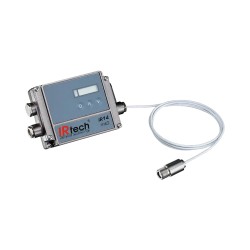
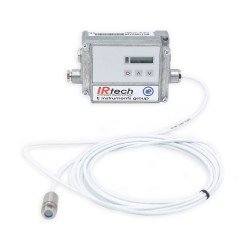
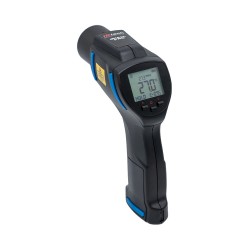
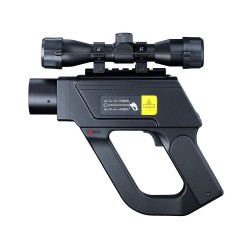
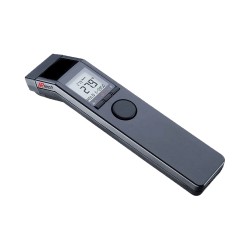
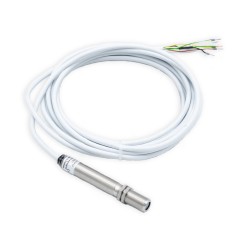
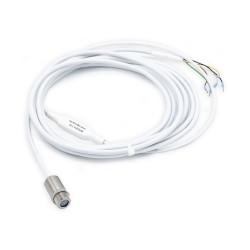
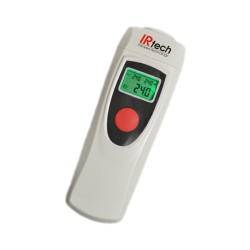
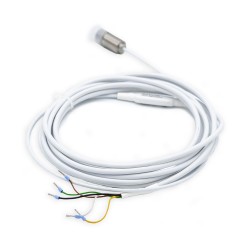
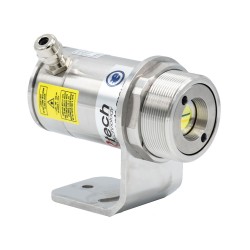
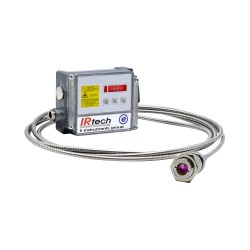
Infrared pyrometers are advanced non-contact temperature measurement tools, ideal for applications requiring precision in harsh environments. These devices detect infrared radiation emitted by objects, allowing you to monitor high temperatures without compromising safety or operational efficiency. Due to their versatility, infrared pyrometers find application in industries such as metal manufacturing, glass processing, chemical industry and predictive maintenance. Our selection includes fixed and portable models, designed to ensure fast, precise and reliable measurements.



Technical FAQ:
Infrared pyrometers
What is an infrared pyrometer?
The infrared pyrometer (or IR pyrometer) is a non-contact temperature measuring instrument that detects the electromagnetic radiation in the infrared spectrum naturally emitted by every body with a temperature above absolute zero. The quantity and wavelength of the radiation depend on temperature according to precise physical laws.
What is an infrared pyrometer used for?
It is used to measure the surface temperature of objects without any physical contact, exploiting the thermal radiation they emit. It is applicable in all contexts where contact measurement would be impossible, dangerous, slow, or invasive: moving objects, high temperatures, electrically live, contaminants, or small dimensions.
In which sectors are infrared pyrometers used?
They are used in metallurgy, glass industry, ceramics, plastics, food, automotive, construction (energy diagnostics), HVAC, electrical maintenance (hot spots on switchboards), aerospace, scientific research, fire brigades, quality control, and in any application requiring non-contact temperature measurements.
What physical principle do infrared pyrometers use for measurement?
They are based on Planck's law, which describes the spectral distribution of radiation emitted by a blackbody as a function of temperature. Each body emits radiation over a range of wavelengths with a characteristic peak (Wien's law) and total power proportional to the fourth power of absolute temperature (Stefan-Boltzmann law: P = ε·σ·T⁴).
What is infrared?
Infrared is a region of the electromagnetic spectrum with wavelengths between 0.7 μm and 1000 μm, located beyond the red of visible light (hence the name 'infra-red') and before microwaves. It is invisible to the human eye but perceptible as heat, and is the main carrier of thermal radiation emitted by bodies at ambient temperature and above.
Which infrared bands do pyrometers use?
The main bands are: NIR (Near InfraRed, 0.7–2 μm) for metals and high temperatures (>500 °C); SWIR (Short Wave IR, 1.4–3 μm) for metals and medium-high processes; MWIR (Mid Wave IR, 3–8 μm) for intermediate applications; LWIR (Long Wave IR, 8–14 μm) for low-temperature surfaces (below 200 °C) and HVAC applications.
What does 'ratio pyrometer' or two-color pyrometer mean?
It is an infrared pyrometer that measures radiation at two different wavelengths simultaneously and calculates the ratio. By exploiting the fact that interferences (emissivity, dust, partial coverage) affect both wavelengths similarly, the ratio automatically compensates for them, providing a more stable and accurate measurement even in difficult conditions.
What is emissivity and why is it important in IR pyrometers?
Emissivity (ε) is the fraction of radiation that a material emits compared to an ideal blackbody at the same temperature. It varies from 0.01 (shiny metals: gold, copper, aluminum) to 0.98 (black paints, carbon, rubber). IR pyrometers apply the emissivity correction to the detected signal to return the correct temperature; incorrect settings generate significant errors.
What is the difference between an IR pyrometer and a thermal camera?
Both use the same principle (infrared radiation detection), but the IR pyrometer measures a single point/area and returns a numerical value; the thermal camera uses a sensor matrix (microbolometer) and provides a 2D thermal image with thousands or millions of pixels, showing the spatial distribution of temperature.
Which materials are difficult to measure with an IR pyrometer?
Unoxidized shiny metallic materials (aluminum, polished stainless steel, copper, silver) have very low and variable emissivity (0.02–0.3), causing unstable measurements. Hot glass also requires pyrometers with specific wavelengths (5.1 μm or 7.9 μm). For these cases, two-color pyrometers or fiber optic models with dedicated wavelengths are preferred.
What happens in the presence of steam, smoke, or dust?
Infrared radiation is partially absorbed or scattered, causing temperature underestimation. Solutions are: choosing a wavelength that penetrates the interference (e.g., MWIR for steam), using two-color pyrometers that automatically compensate for attenuation, or installing air-purge optics that blow clean air in front of the sensor.
Do infrared pyrometers need periodic calibration?
Yes, annual or biennial calibration is recommended to maintain declared accuracy. It is performed by comparing readings with those of a reference blackbody source of known emissivity ≈ 1 and temperature with metrological traceability. For official inspection activities, ISO/IEC 17025 accredited calibration is mandatory.