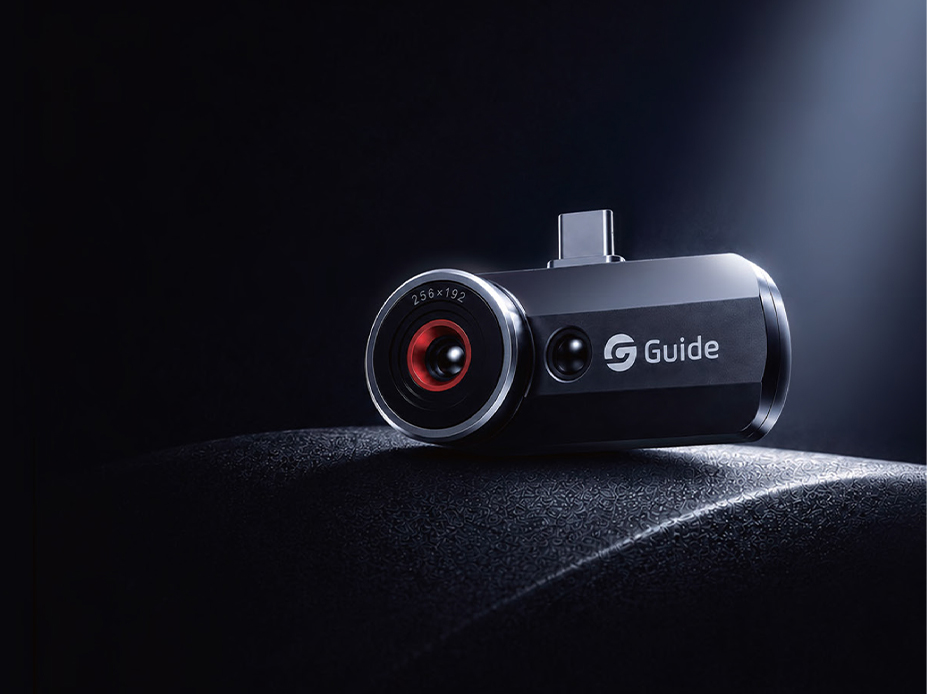
For years, thermography was tied to a dedicated instrument: a thermal imaging camera to carry in a case, switch on, configure and download to a computer at the end of the day. Today, smartphone thermography means having a professional diagnostic tool in your jacket pocket, ready in seconds. This is the idea behind the new smartphone thermal imaging cameras in the MobIR 3.0 series from Guide Sensmart.
A professional sensor in a 25-gram module
The starting point is the manufacturer’s philosophy: all measurement sensors are developed and produced in-house. No third-party components, just full control of the entire supply chain, from the infrared detector to the electronics, right through to the software.
This has an important practical consequence. Having the sensor “in-house” has made it possible to integrate a professional-grade, high-resolution sensor into a module weighing just 25 grams: a pocket-sized thermal imaging camera that connects directly to your phone or tablet and takes up no room in your pocket or in your toolbox.
The practical benefit is simple to state: the instrument is always with you. Thermal diagnostics stops being a planned activity (“I’ll bring the thermal camera”) and becomes a check you can carry out on the spot, whenever something looks wrong.
Ready in 5 seconds: connection and automatic start-up
One of the most appreciated features in the field is how quickly it starts. The module plugs into the phone’s port and the app launches automatically, with no need to look for it among the icons and no configuration steps. From plugging in to the thermal image takes about 5 seconds.
The series is a USB-C thermal imaging camera compatible with Android and iPhone (iOS): the same module therefore works with both Android smartphones and tablets and Apple devices with a USB-C connection. For iPhones with a Lightning connector, an optional USB-C to Lightning adapter is available. In a company where technicians use different devices, different instruments are not needed.
Measuring in real time: spot points, hotspots, areas, profiles and isotherms
The app does more than display the thermal image. It lets you place the analysis tools needed to interpret the scene directly on the screen, in real time:
- spot points: the exact temperature at a point chosen by the operator;
- hotspot: automatic identification of the hottest point in the frame;
- areas: analysis zones with minimum, maximum and average values;
- profiles: the temperature trend along a line, useful for seeing a gradient;
- isotherms and hotspots: highlighting of the zones within a chosen temperature range or above a threshold.
Being able to set all this up during the inspection, and not only during processing, saves time and reduces the risk of realising afterwards that a component was not framed properly.
The measurement range goes from -20 °C to +550 °C, with an NETD of 15 mK on all models: a thermal sensitivity that makes it possible to distinguish very small temperature differences, a fundamental requirement for detecting overheating at an early stage.
Images, videos and PDF reports directly from your phone
What changes the workflow most is what happens after the measurement.
With MobIR 3.0 you can save both thermal images and thermal videos. Video is particularly useful when the temperature changes over time, such as when a motor starts up, during the cycle of an electrical panel or during a plant transient.
Post-processing is done directly on the phone: you can add or move measurement points, change parameters and generate a PDF thermographic report in a few taps. The document can be shared immediately via WhatsApp, e-mail or social media, without going through a computer and without having to remember what was measured when you get back to the office.
For those working in maintenance or service, this means being able to hand a report to the customer, or send a notification to the plant manager, while still standing in front of the machine.
One series, three configurations: ES1, ES2 and ES2+
The MobIR 3.0 series comprises three models, designed for different needs.
- MobIR ES1: 120×90 pixel infrared resolution, the choice for quick checks and for those approaching thermography for the first time.
- MobIR ES2: 256×192 pixel infrared resolution, for more detailed images and for spotting even small anomalies.
- MobIR ES2+: the same 256×192 pixel resolution, with the addition of an integrated camera.
On the ES2+, the camera allows the outlines of objects to be overlaid on the thermal image. In practice, the real profiles of the components are visible on screen over the temperature map, and identifying what you are looking at becomes immediate: a terminal, a fuse or a bearing is no longer a patch of colour to be interpreted, but a recognisable element.
It is a detail that saves a great deal of uncertainty when inspecting crowded panels or complex machinery. All models also feature super resolution, to improve image sharpness, and PIP (picture-in-picture) mode, which lets you show the image from the phone’s camera alongside the thermal image.
Where it is needed: electrical, mechanical and thermal diagnostics
The strength of a portable smartphone thermal imaging camera is its versatility. With the same instrument you can cover different fields that would otherwise require more checks and more equipment.
Electrical diagnostics
In electrical panels, substations and distribution lines, electrical diagnostics with a thermal imaging camera makes it possible to identify loose connections, oxidised contacts, overloads and phase imbalances, which show up as an abnormal temperature rise before causing a fault or a shutdown. The work is contactless and, in most cases, does not require the system to be shut down.
Mechanical diagnostics
On motors, gearboxes, bearings, pumps and transmissions, a temperature anomaly is often the first sign of excessive friction, insufficient lubrication or misalignment. Periodic thermal checks help to intervene before the component is damaged.
Thermal and building diagnostics
When checking air-conditioning and heating systems, looking for leaks or blockages and monitoring environments, the thermal imaging camera makes visible what could otherwise only be guessed at. The applications listed for the series also include home monitoring and outdoor activities.
Support for predictive maintenance
Periodic thermal checks are one of the simplest ways to set up predictive maintenance with thermography: images are recorded over time, compared, and action is taken when a component begins to deviate from its normal behaviour. Being able to save and share data from the phone makes this process much leaner.
Why choose a smartphone module
A traditional thermal imaging camera remains the right solution for those who do thermography on a continuous basis and need advanced functions. But for many technicians the problem is different: the right instrument is the one you have with you when you need it. A 25-gram module that starts in 5 seconds and produces a report that can be shared immediately solves exactly this problem.
To sum up, the strengths of the MobIR 3.0 series are:
- high-resolution sensor developed in-house by the manufacturer;
- module weighing just 25 grams, connectable via USB-C;
- compatibility with Android and iOS;
- automatic app start-up in about 5 seconds;
- spot points, hotspots, areas, profiles and isotherms in real time;
- saving of thermal images and videos;
- PDF report and sharing directly from the phone;
- ES2+ with integrated camera and overlay of object outlines.
Discover the MobIR 3.0 smartphone thermal imaging camera and explore the full range of E Instruments portable thermal imaging cameras.
Our technical team is available to analyse your application and help you choose the model best suited to your needs.