Temperature probe calibration is one of the most critical and frequent activities in metrology laboratories, quality departments and industrial production environments. Ensuring that temperature probes and field transmitters measure correctly is not only a regulatory requirement — it is a necessary condition for product quality, process safety and compliance with international standards.
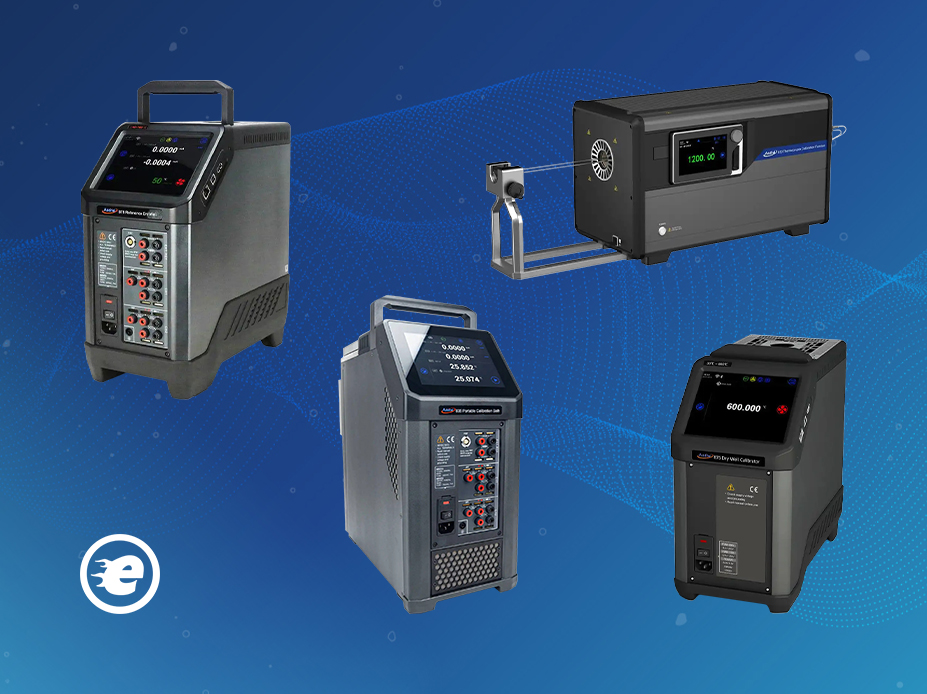
E Instruments distributes the complete line of Additel dry-well temperature calibrators throughout Italy: instruments designed to deliver the best combination of speed, stability, accuracy and connectivity currently available on the market, with specific attention to the requirements of Industry 4.0.
What is a dry-well temperature calibrator and how does it work
A dry-well temperature calibrator is an instrument that generates a stable, uniform heat source inside an interchangeable metal insert, into which the temperature probes to be verified are inserted. Unlike liquid calibration baths, the dry well uses no process fluid: the metal insert transfers heat to the probe by direct conduction, ensuring a fast response and clean, safe operation even in production environments.
The operating principle is straightforward: the calibrator brings the block to the desired reference temperature, the probe under test is inserted into the insert, and its indicated value is compared with that of the reference sensor (typically a high-accuracy PRT — Platinum Resistance Thermometer — integrated into the instrument). The difference between the two values constitutes the probe error, which is recorded in the calibration certificate.
Thermocouple and resistance thermometer calibration: requirements and challenges
Industrial temperature probes fall into two main categories: thermocouples (type K, J, T, N, S, R, B…) and resistance thermometers (PT100, PT500, PT1000, Ni…). The two technologies have very different characteristics — thermocouples cover extremely wide temperature ranges (up to 1700°C and beyond for certain types), while resistance thermometers offer greater accuracy and repeatability in ranges up to 600–850°C — and they require different calibration approaches.
Thermocouple calibration presents specific challenges: drift over time is significant, thermal hysteresis can introduce systematic errors, and the high temperatures required call for heat sources that are stable and uniform across the full length of the probe. Calibration of PT100 and other resistance thermometers, on the other hand, demands higher measurement resolution and display accuracies that can reach ±0.1°C or better in reference models.
In both cases, the key is to have a stable, uniform and well-characterised thermal source — exactly what the Additel dry-well temperature calibrators are designed to provide.
Connectivity and Industry 4.0
All models in the Additel range are designed to integrate fully into the digital workflows of Industry 4.0. Every instrument is equipped with Wi-Fi, Bluetooth, USB and RJ45 Ethernet connectivity and can be operated in three modes:
- Via serial or Ethernet: direct integration with LIMS software, quality management systems or supervisory PCs;
- Via mobile app (Additel Link): remote cloud control, useful for monitoring ongoing calibrations or reviewing results from a distance without being physically present in the laboratory;
- Via Bluetooth locally: configuration and data reading directly from a smartphone, ideal for field interventions.
Models with the Process Calibrator (PC) option add a scanner for signal acquisition: measurement channels for mA, voltage, switch, RTD and thermocouples, with automatic calibration documentation capability and HART functions for configuring field transmitters. This option transforms the dry well from a simple thermal source into a complete, self-documenting calibration station — a particularly well-timed investment for those who must comply with ISO 9001 or ISO/IEC 17025 traceability requirements.
Typical applications
Verification of probes in climatic chambers and ovens
Climatic chambers, industrial ovens and polymerisation tunnels are equipped with dozens of industrial temperature probes that must be verified periodically to ensure that process conditions match the nominal values. A portable dry-well temperature calibrator allows this verification to be carried out directly on site, without removing the probes and without interrupting the process any more than necessary.
Calibration of process transmitters
Temperature transmitters installed on production lines, reactors, pasteurisers, autoclaves and pharmaceutical plant must be calibrated periodically against certified reference standards. Additel models with the Process Calibrator option allow thermocouple and resistance thermometer calibration to be performed directly in the field, automatically generating the calibration certificate and configuring the HART transmitter in a single operation.
Metrology laboratories and quality departments
In ISO/IEC 17025 accredited laboratories and in the quality departments of ISO 9001 certified companies, temperature probe calibration is part of a structured process with precise accuracy, repeatability and traceability requirements. The reference models in the ADT878 series are designed specifically for this context, with display accuracies down to ±0.1°C and resolutions of 0.001°C.
High-temperature thermocouple calibration
In the metallurgical, ceramic, glass and heavy industry sectors, calibration of type K, N, S, R and B thermocouples at temperatures above 600°C requires horizontal calibration furnaces with long, uniform working zones. The ADT875-1210, ADT878-1210 and ADT850 models cover exactly this scenario.
E Instruments: the Additel range
ADT875 — Industrial dry-well calibrator: the fastest on the market
The ADT875 is the industrial temperature calibrator in the Additel range, designed for those who need speed, robustness and portability without compromising on performance. Available in four models covering -40°C to 1210°C, with dual-zone control, a 6.5" colour touchscreen and Wi-Fi, Bluetooth, USB and Ethernet connectivity.
The ADT875-155 model (-40°C/+155°C, accuracy ±0.18°C) is currently the fastest dry-well calibrator available on the market: ramp-up and ramp-down times to the set-point temperature are significantly shorter than those of competing products, substantially reducing idle time between calibrations — a concrete advantage in high-volume calibration environments.
The ADT875-1210 version is a patented multi-zone calibration furnace designed for thermocouple calibration up to 1210°C with excellent stability and uniformity. Available with or without the integrated Process Calibrator option.
ADT878 — Reference calibrator for metrology laboratories
The ADT878 is the reference dry-well temperature calibrator, designed for metrology laboratories and quality departments where accuracy is the primary requirement. Available in four models from -40°C to 1210°C, with a resolution of 0.001°C — ten times higher than the ADT875 — and display accuracies down to ±0.1°C in the 878-160 model.
The ADT878-160 model also features an automatic Triple Point of Water (TPW) programme for the realisation and maintenance of a TPW cell, useful for tracking probe drift over time — a function exclusive to primary metrology laboratories. The ADT878-700 model includes an automatic annealing function for PRTs, which reduces accelerated drift following exposure to high temperatures. The ADT878-1210 version is likewise a patented multi-zone calibration furnace for high-temperature thermocouples.
ADT835 — Portable calibration bath
The ADT835 is the Additel portable calibration bath, designed for the simultaneous calibration of a large number of temperature probes in a single cycle — up to 4 sanitary sensors with a 50mm stem or 40 probes with a 6.35mm stem. The operating range extends from -30°C to 250°C, with point-to-point Bluetooth or Wi-Fi hotspot connectivity and cloud mode via Wi-Fi network or LAN port for the centralised management of multiple baths simultaneously.
It is the ideal solution both for industrial field use — where many probes need to be calibrated in a single session — and for laboratory use, where multi-sensor capacity significantly increases productivity.
ADT850 — High-temperature thermocouple calibration furnace
The ADT850 is the horizontal calibration furnace for high-temperature thermocouple calibration in metrology rooms and quality departments. With an operating range from 300°C to 1200°C and multi-zone control for maximum axial uniformity, it is the reference instrument for those who need to calibrate type S, R, B and N thermocouples in the most demanding laboratories. The horizontal design facilitates the insertion of long thermocouples and ensures optimum thermal distribution along the entire working zone.
How to choose the right model
The choice depends primarily on the operating context and the accuracy required.
For predominantly industrial use — field verification, on-site transmitter calibration, production quality control — the ADT875 series is the natural choice: portable, fast, robust and with the PC option for on-site calibration documentation. The ADT875-155 is the first choice for those working mainly in the range up to 155°C who want to minimise cycle times.
For metrology laboratories and quality departments that must meet stringent accuracy requirements and produce traceable certificates, the ADT878 series delivers the necessary reference-level performance, with superior resolution and accuracy.
For those who need to calibrate many probes simultaneously, the ADT835 bath is the only efficient solution: it drastically reduces the number of cycles required compared with a single-channel dry well.
For high-temperature thermocouple calibration in structured metrological contexts, the ADT850 furnace is the dedicated instrument, with the uniformity and stability characteristics that only a multi-zone horizontal furnace can provide.
The E Instruments technical team is available to analyse application requirements, recommend the most suitable model and support the integration of instruments into existing quality management systems.