


Calibration baths for calibration
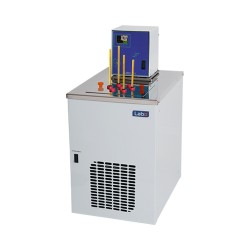
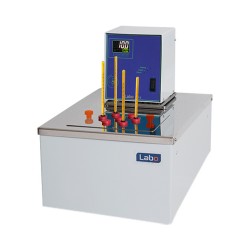
Our calibration baths offer a reliable and high-performance solution for temperature calibrations. Using a dedicated fluid they make it possible to calibrate numerous sensors simultaneously. This type of solution is dedicated to metrology laboratories or sensor manufacturers. The instruments are designed to certify thermocouples, thermoresistances or sensors from the lowest to the highest temperatures, covering all needs.

Technical FAQ:
Calibration baths for calibration
What are calibration baths?
Calibration baths are temperature-controlled systems that generate a highly uniform and stable thermal environment using a heat transfer fluid (water, silicone oil, alcohol, or specific mixtures). Both the device under test and the reference probe are immersed in the same fluid volume, ensuring excellent thermal stability and high repeatability.
What are calibration baths used for?
They are used to calibrate temperature probes, thermometers, RTDs (Pt100, Pt1000), thermocouples, and thermistors with very high accuracy, both in metrology laboratories and in industrial environments with strict quality requirements. They are particularly suitable for calibrations below 300 °C, where liquid-based stability is superior to dry block systems.
In which industries are calibration baths used?
Calibration baths are widely used in accredited metrology laboratories, calibration service providers, pharmaceutical (GMP), food (HACCP), petrochemical, automotive, aerospace, energy, and any sector where temperature measurement quality is critical for process control or regulatory compliance.
What is the difference between a calibration bath and a dry block calibrator?
A calibration bath uses a liquid medium to transfer heat, providing very high uniformity and stability (typically ≤ ±0.005 °C) and accommodating probes of virtually any geometry. A dry block calibrator uses a solid metal block, offering faster operation, portability, and cleaner handling, but with lower uniformity and constraints due to fixed insert geometries.
Which heat transfer fluids are used in calibration baths?
Common fluids include deionized water for the 5–95 °C range, silicone oil for wider ranges (−40 to 250–300 °C), alcohol or low-freezing-point mixtures for low temperatures (down to −80/−90 °C), and molten salts for high-temperature applications. The choice depends on temperature range, viscosity, safety, and compatibility with the probes.
What temperature ranges do calibration baths cover?
Depending on the model and fluid used, calibration baths typically cover a range from about −90 °C up to 300 °C. Cryogenic baths can reach even lower temperatures, while higher temperatures are generally handled by dry block calibrators or specialized molten salt systems.
What level of accuracy can a calibration bath achieve?
High-end metrology baths can achieve stability of ±0.001 to ±0.005 °C and uniformity of ±0.002 to ±0.01 °C within the working zone. This enables calibration uncertainties better than 0.01 °C when used with a high-accuracy reference probe.
What do thermal uniformity and stability mean?
Uniformity refers to the maximum temperature difference between different points in the working volume at the same time. Stability refers to the maximum temperature variation at a fixed point over a given time period. Both parameters significantly affect the overall calibration uncertainty.
How is a calibration performed using a calibration bath?
The device under test and the reference probe are immersed at the same depth in the thermostatic bath. A thermal stabilization period is required (typically 20–30 minutes per point). Measurements from both instruments are compared, and deviation and uncertainty are calculated according to ISO/IEC 17025 requirements.
Which instruments can be calibrated in a bath?
RTDs (Pt100, Pt1000), thermocouples, thermistors, digital probes, liquid-in-glass thermometers, temperature dataloggers, and any immersible temperature sensor can be calibrated, provided it is compatible with the selected fluid and meets minimum immersion depth requirements.
Which standards apply to calibration baths?
Key standards include ISO/IEC 17025, EURAMET cg-13 (Calibration of Temperature Block Calibrators), ITS-90 (International Temperature Scale), and ACCREDIA guidelines for accredited temperature calibration laboratories.
How often should a calibration bath be calibrated or verified?
The bath itself is a temperature generator and typically does not require frequent recalibration. Instead, the reference thermometer or probe must be calibrated periodically (usually annually). The bath requires periodic performance verification and mapping of uniformity and stability, generally every 1–2 years.