


Optical pyrometers
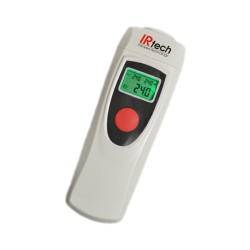
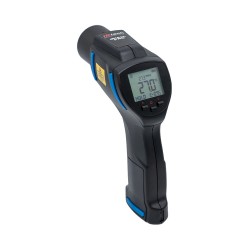
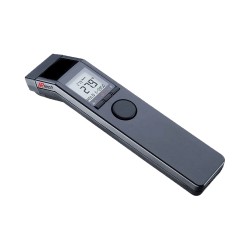
Our selection of optical pyrometers consists of essential tools for precise thermal measurements in industrial environments. Our optical pyrometers ensure precision and reliability, ideal for temperature control in production and research processes. We offer a variety of models, each designed to meet specific measurement needs, ensuring accurate and repeatable results. You will have access to state-of-the-art optical pyrometers that combine advanced features and ease of use to improve the efficiency and quality of thermal control in your sector.
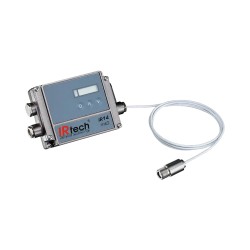



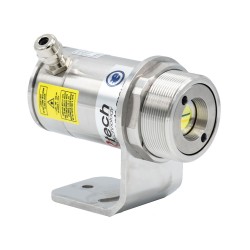
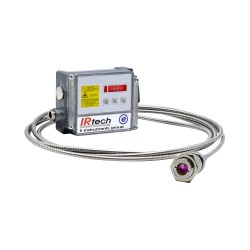
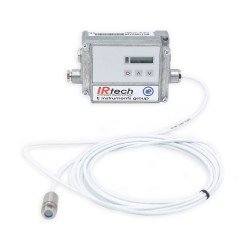
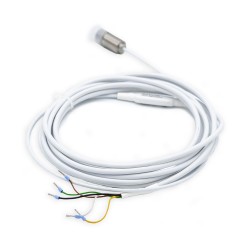
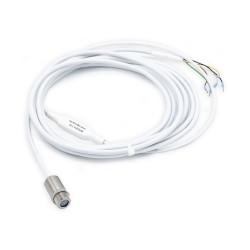
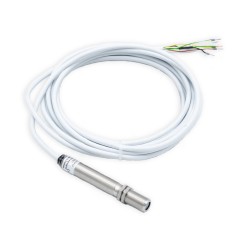
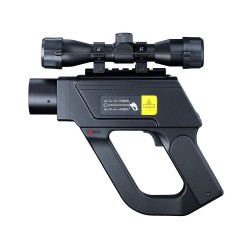
Technical FAQ:
Optical pyrometers
What is an optical pyrometer?
An optical pyrometer is a non-contact temperature measuring instrument characterized by an advanced optical system for aiming and collecting infrared radiation. It includes models with integrated visual viewfinder, high-resolution focusing lenses, fiber optic systems for harsh environments, and two-color (ratio pyrometer) technology for measurements on partially obscured objects or those with uncertain emissivity.
What is an optical pyrometer used for?
It is used to measure with high accuracy the temperature of specific objects even at great distances or in difficult conditions (presence of smoke, dust, interposed windows, small or partially hidden objects). It is preferable to a standard pyrometer when aiming precision and optical quality are critical.
In which sectors are optical pyrometers used?
They are used in metallurgy (rolling mills, foundries, quench furnaces), glass industry, ceramics, semiconductors, advanced plastics, scientific research, aerospace, and in any application requiring high precision non-contact temperature measurement in complex environments.
What is the difference between an optical pyrometer and a laser pyrometer?
The laser pyrometer uses the laser as a visual aid for aiming, but has standard optics. The optical pyrometer integrates an advanced optical viewfinder or focusing system (eyepiece, telescope, motorized lenses, fiber optics) to ensure maximum aiming precision on small objects or at great distances.
What is a two-color (ratio) pyrometer?
It is an optical pyrometer that measures infrared radiation at two different wavelengths simultaneously, calculating the ratio between the two. This method allows accurate measurements even when the target is partially covered, has uncertain or variable emissivity, or is observed through smoke or dust — situations in which a traditional single-color pyrometer would give significant errors.
When is a fiber optic pyrometer necessary?
It is necessary when the sensor must be installed far from the measurement point (due to high ambient temperatures, vibrations, inaccessible spaces, intense electromagnetic fields). The fiber optic transports the IR radiation from the target to
the electronic sensor installed in a safe area. Typical in induction furnaces, welding applications, plasma processes, and ATEX environments.
What are interchangeable optics?
They are modular lenses replaceable on the pyrometer body that modify the D:S ratio and focal distance, adapting the instrument to different applications: wide-angle optics for broad close-range coverage, short focal optics for laboratory applications, telephoto optics for long-distance measurements (10–50 m), macro optics for very small objects (1–2 mm).
What does measurement wavelength mean?
It is the specific band of the infrared spectrum in which the pyrometer detects thermal radiation. Typical bands are MWIR (3–5 μm, for metals and high-temperature processes), LWIR (8–14 μm, for low-to-medium temperature surfaces), NIR (0.9–1.7
μm, for molten metals, above 600 °C). The choice of the correct wavelength depends on the material, temperature, and environmental conditions.
What optical resolution do optical pyrometers achieve?
Professional optical pyrometers achieve D:S ratios of 100:1, 180:1, up to 300:1 in high-resolution models, enabling measurements on objects of a few millimeters from meters away. For comparison, generic portable pyrometers have D:S of 12:1–30:1.
Are there fixed and portable optical pyrometers?
Yes, they are available in both configurations: fixed optical pyrometers for permanent installation on industrial process lines, and portable optical pyrometers for laboratory, R&D, precision maintenance, and inspection applications.
What complementary accessories are available for optical pyrometers?
Air purge (compressed air nozzles for optical cleaning), water-cooled tubes for very hot environments, sapphire/ZnSe/CaF₂ protection windows, adjustable flanges and mounts, dedicated fiber optics, high-resolution optical viewfinders, data acquisition and analysis software, and reference blackbodies for calibration.
How accurate is a professional optical pyrometer?
Typical accuracy is ±0.5% of the reading + 1 °C, down to ±0.3% in premium models for metrological applications. Repeatability is even better (±0.1%), and in two-color models the sensitivity to emissivity and partial coverage is significantly reduced compared to single-color models.