


Industrial and professional Pyrometers
The industrial pyrometers and professional pyrometers we have selected are instruments designed to ensure extreme precision, durability, and reliability in the most demanding conditions. With a wide range of models, we offer ideal solutions for every industrial need, from low-temperature applications to those with high thermal intensity. Each pyrometer is built with cutting-edge technology, ensuring accurate and consistent measurements over time. Choose quality to monitor temperatures with maximum efficiency and safety.
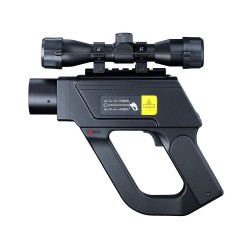

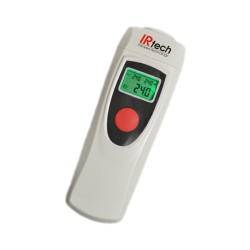
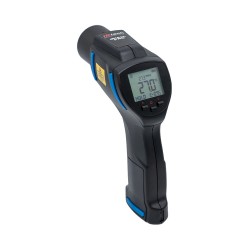
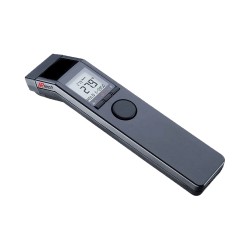
Technical FAQ:
Industrial and professional Pyrometers
What is an industrial pyrometer?
An industrial pyrometer is an instrument used to measure the temperature of an object or process without direct contact. Unlike contact sensors, the pyrometer detects the infrared radiation emitted by the surface and converts it into a temperature value. This technology is particularly useful in the presence of moving objects, high temperatures, hard-to-reach materials or processes where physical contact is not possible.
What is the difference between laser pyrometer and infrared pyrometer?
An infrared pyrometer measures temperature by detecting the IR energy emitted by the surface. The laser, however, does not measure the temperature: it only serves as a pointing system to help the operator precisely locate the measurement area. For this reason, a laser pyrometer is generally an infrared pyrometer equipped with a laser pointer.
How does emissivity affect the measurement of a pyrometer?
Emissivity indicates the ability of a material to emit infrared radiation. It is one of the most important parameters in pyrometric measurement, because an incorrectly set value can generate inaccurate readings. Opaque and non-reflective materials generally have more stable emissivity, while shiny, metallic or reflective surfaces require more careful configuration of the instrument.
When to choose a fixed pyrometer?
A fixed pyrometer is indicated when it is necessary to continuously monitor the temperature of a production process. It is installed directly on the system and can be integrated with control systems, alarms, PLC or supervision software. It is particularly useful in applications such as metalworking, glass, plastic, industrial ovens, production lines and automated thermal processes.
When is it preferable to use a portable pyrometer?
A portable pyrometer is the ideal choice for quick checks, field checks and maintenance activities. It allows the operator to carry out non-contact measurements in different points of the system, without fixed installations. It is particularly useful for periodic inspections, checks on machinery, verification of surface temperatures and preliminary diagnoses.
Which materials can be measured with a pyrometer?
Pyrometers can be used to measure the temperature of numerous materials, including metals, glass, ceramics, plastics, rubber, paper, organic materials, and painted surfaces. The choice of model depends on the temperature range, wavelength, emissivity of the material and the environmental conditions of the process.
What does optical ratio mean in a pyrometer?
The optical ratio, often referred to as D:S, defines the relationship between the measurement distance and the diameter of the measured area. A high optical ratio allows you to measure small objects even from greater distances, while a lower ratio is suitable for close-up measurements or on large surfaces. Choosing the correct optical ratio is essential to obtain reliable measurements.
Can pyrometers be used in harsh industrial environments?
Yes. Industrial pyrometers are designed to operate in complex environments, including high temperatures, dust, fumes, vibrations or operating conditions burdensome. In these cases it is important to choose suitable models, possibly with protective accessories, cooling systems, dedicated cases or specific optics.
How do you calibrate a pyrometer?
The calibration of a pyrometer occurs by comparing the measurement of the instrument with a known reference source, such as a black body. The blackbody provides a stable and uniform temperature, allowing you to verify the accuracy of the pyrometer and correct any deviations. Periodic calibration is essential to guarantee reliable and traceable measurements over time.
What role does the software have in using pyrometers?
The software allows you to acquire, view, record and analyze data from pyrometers, especially in continuous monitoring systems. It can be used to create thermal trends, set alarm thresholds, generate reports and integrate temperature data into industrial control processes.
How to choose the most suitable pyrometer for your application?
To choose the correct pyrometer it is necessary to evaluate various technical parameters: temperature range, type of material to be measured, emissivity, measurement distance, object size, response time, installation environment and need for integration with control systems. In complex industrial applications it is advisable to rely on specialized technical consultancy to identify the most suitable solution.